
INTRODUCTION
In a context marked by persistent voter apathy and underrepresentation of youth and women in electoral processes, Actions for Development and Empowerment, ADE with support from the National Endowment for Democracy, NED, organized a unique civic engagement initiative titled “Run to Register: A Socio-Cultural Horse Race to Increase Youth and Women Participation in Electoral Processes.” This event organised in collaboration with Actions Citoyenne de Jeunes Ambassadeurs de la Paix et du Développement Inclusif Durable (ACIJAP) and Federation Camerounaise des Sports Equestres on June 9, 2025, at Place de fête Ngaoundéré, as formed part of the “My Vote, My Voice” project and was designed to blend civic education with local cultural expressions to inspire greater democratic participation.
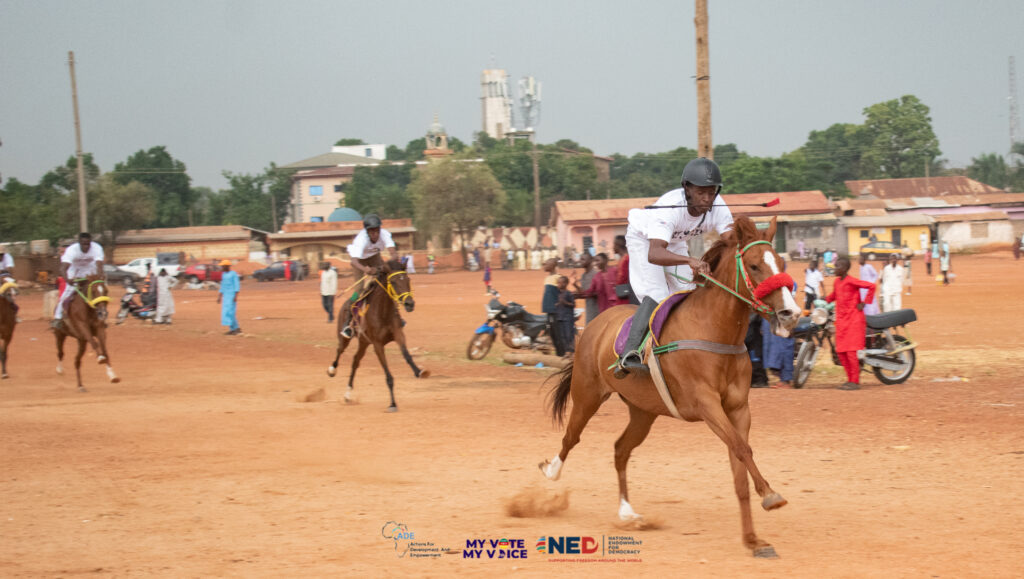
Held in the Vina Division of the Adamawa region, an area with notably low voter registration, especially among youth and women, the horse race served as an innovative platform to raise awareness, promote voter registration, and build community ownership of the electoral process. The key objectives of this socio-cultural event was to (i) To sensitize youth and women in the Vina Division on the importance of voter registration and political participation (ii) To collaborate with local cultural influencers to raise awareness of the electoral process in a manner that resonates with the community (iii) To directly register eligible voters, especially youth and women, during the event in partnership with ELECAM and (iv) To foster community ownership of the electoral process by linking civic duty to cultural identity.
OVERVIEW
The event commenced at about 1pm with the arrival of Elections Cameroon, ELECAM’s mobile registration unit. Their team of eight officials, equipped with biometric voter registration kits, began by setting up a mobile registration desk at the event grounds. They began enrolling eligible citizens who arrived early, particularly targeting youth and women who had been mobilized through prior outreach. ADE volunteers were stationed to assist in crowd control and document verification, especially the national ID cards which is a key tool used for voter registration.
Consequently, key guests and dignitaries began arriving at the venue, including representatives from the Mayor’s office, MINJEC, CNJC, ELECAM regional leadership, and traditional authorities. ADE welcomed them formally, providing them with a brief overview of the event’s purpose and expected impact.
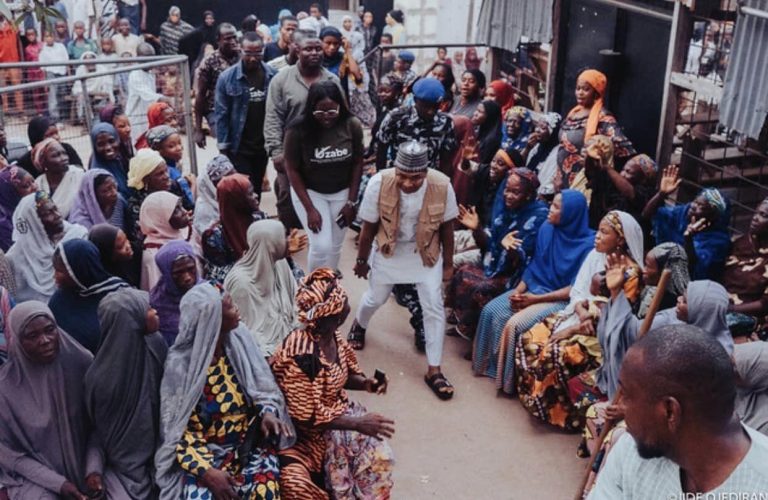
To build momentum and engage the community, a vibrant traditional dance performance by a local cultural group captured the attention of the audience and created an atmosphere of celebration. The dancers, clad in traditional attire, incorporated themes of civic responsibility and community unity into their performance, delivering powerful messages in the local language, Fulfulde, about why voting matters.
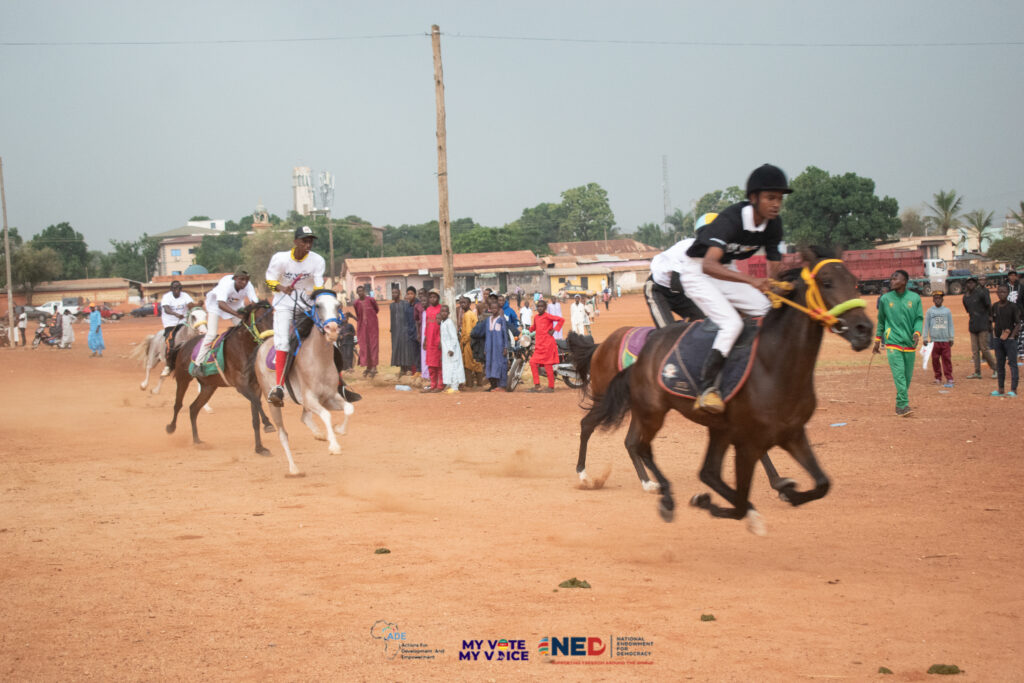
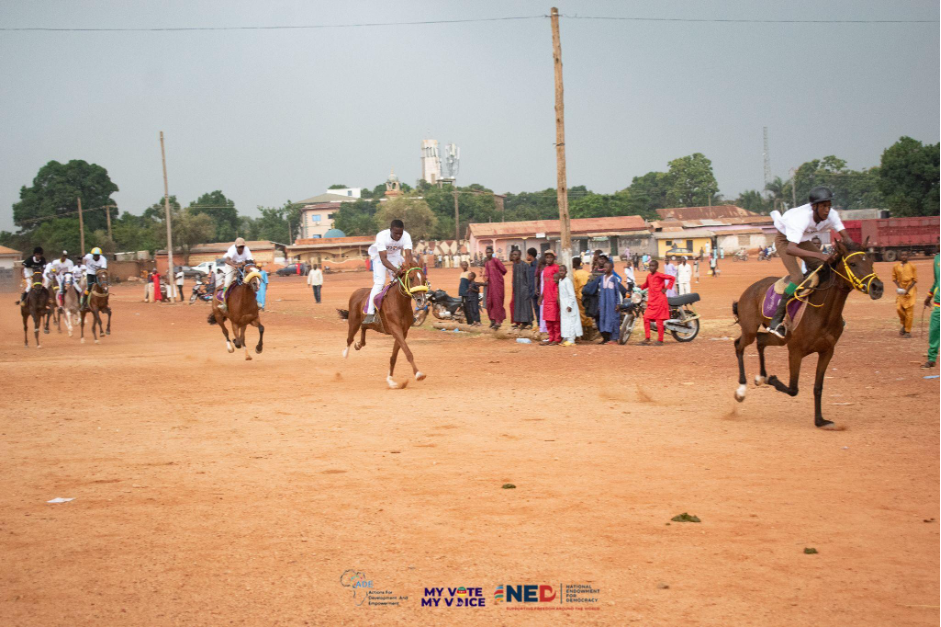
Following the performance, 10 well-trained local horse riders (6 female and 4 male) wearing t-shirts branded with civic slogans like “My Vote, My Voice” participated in the first race for a 1200 M distance. Spectators lined both sides of the designated race path, and cheers erupted as horses galloped past cheering youth and women, many of whom had never witnessed a public horse race of this scale. The MC provided live commentary, linking the horse race to the concept of taking charge of one’s future through registering to vote.
At about 4pm, the second and final round of the horse race saw heightened enthusiasm as riders competed for the top prize with a 1400 M distance. This segment was made up of 6 male and 4 female riders. Commentary from the event MC linked the competition to the democratic process emphasizing that just like in a race, every vote counts and everyone must take part to achieve victory. This portion drew in onlookers from nearby neighbourhoods, increasing visibility and participation at the ELECAM stand.
After the second race, the winners of the two races were called forward and awarded prizes, including cash gifts and medals, to the best three while other racers received participatory prizes . Representatives from ELECAM, MINJEC, ACIJAP, and ADE handed out the prizes to the racers.
CLOSING REMARKS
The closing remarks were given by Mr ABDOULAYE BOUBA, Executive Director of ACIJAP on behalf of Ms Nancy Siaboh, who began by thanking everyone present for taking out time to attend the event. Special thanks was given to the representatives from government institutions, ELECAM, the racers and partners. He laid emphasis on the need for sustaining the momentum generated, with encouragement to follow up at ELECAM offices for those unable to register on-site. He concluded by encouraging youths to spread the word about voter registration by encouraging their peers and families to register on the electoral list for sustained democratic participation.
RESULTS AND ACHIEVEMENTS
1. On-Site Voter Registration: 50 new voters registered on-site by ELECAM. Many of the registrants were first-time voters, including students from the University of Ngaoundéré, market women, and commercial motorbike riders.
2. Wide-Scale Civic Sensitization: The event directly reached over 500 attendees with civic education messages. Through performances, banners and flyers about 500 youth and women received targeted messages about the importance of voter registration and political participation.
3. Strengthened Institutional Collaboration: The event fostered multi-stakeholder collaboration between civil society, state institutions, ELECAM, traditional authorities, youth councils (CNJC), and private sector actors. ELECAM staff commended the initiative for creating an enabling environment for mobile voter registration and expressed interest in partnering on future outreach campaigns.
4. Cultural Relevance as a Tool for Engagement: The use of a horse race, a highly respected cultural sport in the Adamawa region served as a strong mobilizing force, attracting community members who might not otherwise attend civic events.
LESSONS LEARNED
- Incorporating local traditions such as horse racing and cultural dance proved to be a powerful method for engaging youth and women. People were not just attending a civic event; they were participating in a celebration of identity. This significantly increased attendance and attention to voter education messages.
- Awarding medals and symbolic prizes demonstrated that civic engagement can be recognized and rewarded. Such gestures build confidence, especially among underrepresented groups like young women, and encourage sustained participation.
CHALLENGES ENCOUNTERED
- A significant number of interested attendees, particularly young women and displaced persons, were unable to register on-site due to lack of National ID cards, a prerequisite for voter registration. This limited the total number of registrants
- Although the event began under clear skies, heavy rainfall occurred shortly after the second horse race, disrupting the final stages of the program. This sudden downpour affected crowd movement and limited the number of last-minute voter registrations. The experience underscores the need for contingency planning for weather-related disruptions for future outdoor events.
- Some members of the community were initially hesitant to participate in the initiative due to concerns that it might be politically affiliated. This led to reluctance and a lack of engagement from those who did not wish to be seen as endorsing any political ideology.